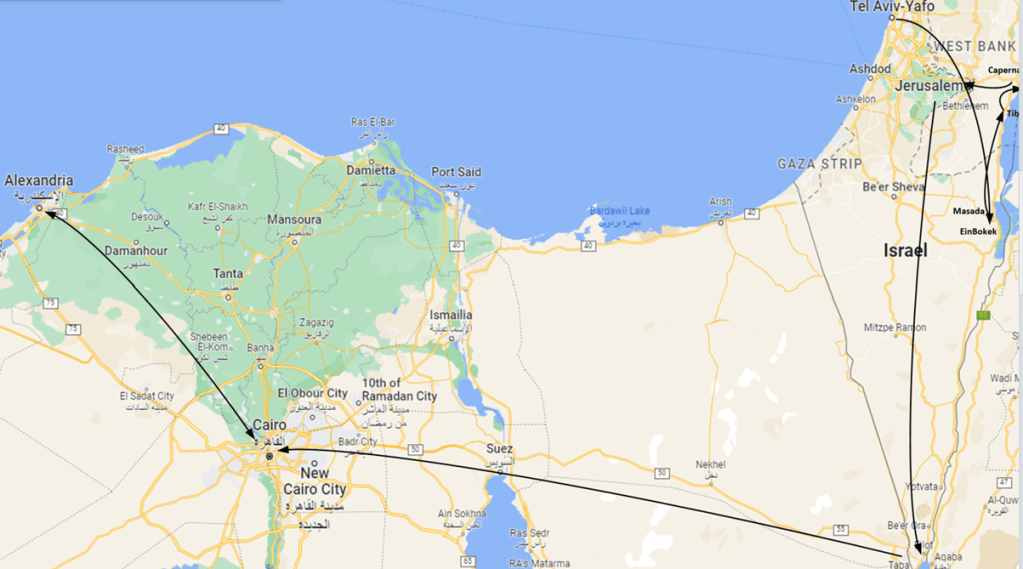
Israel – a conundrum of complexities
We arrived in Tel Aviv at an unearthly hour in the middle of the night and valiantly jumped through the incoming tourist hoops, and endured the rude staff, to find ourselves in the arrivals hall. Having been earlier warned, not in a dream but by text, to avoid taxi hustlers and to download the Gett app to order a taxi, we proceeded as instructed to Exit 23 on Level 2 and requested a taxi to take us to the Best Western suites in Tel Aviv. A driver named Ogor driving a Toyota was selected for us and the app suggested it would be a 7 minute wait. As I watched the crowds while we waited I was thankful for my friend David’s advice to shoo away the taxi hustlers and stick to the Gett app. In less than a minute I was approached by a man and just as I was about to shoo him away he showed me his phone, with my name on the screen. I protested that he was not due for another 6 minutes to which he shrugged his shoulders to show that he really was there and he led us to a Toyota. We loaded our bags and jumped in and settled back for the 20 minute ride to the city. As we approached the hotel I got a phone call from a taxi driver called Ogor who was waiting at the airport and wondering where I was. I told him we were approaching the City in what I thought was Ogor’s car. When we got to the hotel the driver, said the app wasn’t working and the payment didn’t go through. I protested that i didn’t have any shekels so he relieved me of a few euros instead. At the Hotel check-in we were subjected to the usual registration rituals and we were given our room key. it was now 3:00am. When we got to the room it was clear that it had not been cleaned from the previous guests so it was back down to reception where the night attendant didn’t believe me and insisted on accompanying me up to the third floor to show me how silly I was. He soon turned apologetic and assigned us a room on the first floor. He gave me a bottle of wine and asked me not to tell the manager in the morning. Lorna and i were soon in a well deserved sleep.
It was 10:00 AM when we woke up, dressed and wheeled our bags down to reception. “We are checking out of 305,” I said. “Don’t you mean 103?” was the reply. The hotel manager apologized again and invited us to get a bottle of drink from the fridge, ‘on the House’.
Tel Aviv is a vibrant city. It’s on the Mediterranean and has a long coastline of fine beaches. It has cafes, shops and restaurants and mostly young people, that gives it an air of vitality. There’s also much construction going on, indicating a healthy economy.
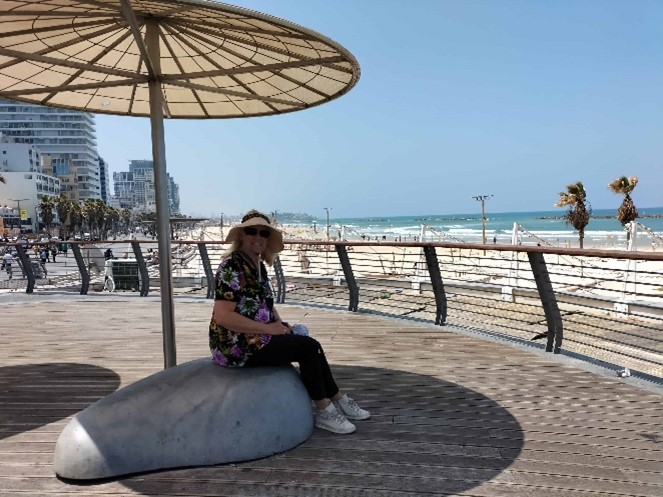
We went to the Esplanade along the beach and found the market that we had been told about, where we bought some fruit to take with us and we were back to the hotel lobby for 1:30pm to meet David.
David is a friend from primary school who had tracked me down via the secondary school I had attended in England. He was the reason for our trip to Israel, our previous two attempts being thwarted first by the Cunard Cruise line and then by COVID. David turned out to be gregarious and we soon hit it off. He drove us to Ein Bokek on the Dead Sea. We had a reservation at the largest hotel, the Royal Dead Sea Hotel and Spa. We checked in and proceeded to our room. The extravagance of the hotel facade soon faded as we got out of the elevator and attempted to find our room along corridors with room numbers missing and carpets fraying. We eventually succeeded and the card key opened the door to our room. It was a spacious room with a large king-sized bed and an annex with a pullout couch. We climbed into our pajamas and were soon fast asleep.
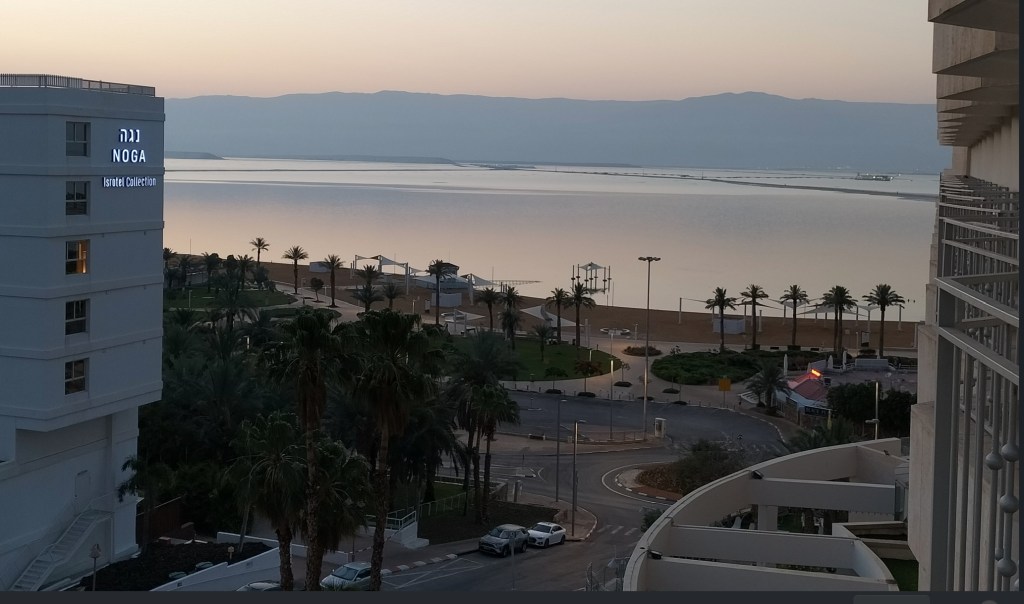
Awakening in the morning we looked outside to see the Dead Sea living up to its name, it was deserted, dead calm with a haze hanging over it. We decided to go for a dip before breakfast so we put on our togs and headed for the beach. The water felt light and smooth on the skin. As you immersed yourself in it, it became obvious you could float. Leaning back your feet automatically rise and you float effortlessly. Rolling on your front and trying to swim is pointless, kicking your feet is useless because they don’t connect with the water for propulsion, they just kick the air and splash the top of the water. I put my head under but I was careful not to get any water in my mouth because a mouthful can kill you. There are continual announcements in Hebrew and English that if you ingest the water you must attend the first-aid station for treatment.
Following a truly surreal experience we washed off and went to our room to change before going down for breakfast. It was bedlam. The hotel’s primary market is tour groups of retirees who obviously relish the breakfast included in their ‘package’. The array of food is impressive from omelets to pasta, bread to salad. Groups set-up long tables onto which they deposited heaping plates of all kinds of food and full loaves of bread. Twenty minutes later they would vacate the table with only half the food eaten. Lorna and I filled our plates with what we wanted to eat, and we ate it. After our late breakfast we decided to explore and I asked at reception regarding the town of Ein Bokek.
“How do I get to Ein Bokek,” I asked. The man on the front desk had Tourette’s syndrome and flinched several times as he answered.
“Do you have a car?” he said. An obviously redundant question.
“No,” I answered.
“You can’t,” he said.
“Is there a bus?” I questioned.
“No,” was the response.
“Is there a taxi,” I queried further.
“No,” he replied.
“How far is it?” I asked, thinking maybe we could walk. “One kilometer, 5 kilometers, 10 kilometers?” I suggested.
“Fifteen,” he replied.
Giving up on the elusive town, which I later found out didn’t exist, we decided to walk to a small shopping mall that we had seen when David had dropped us off the previous evening. As we ventured out, the temperature now over 30 degrees, we looked at several shops before stopping for lunch. Lorna saw McDonald’s and wondered if they did Frappuccino’s, I went to the ordering screen to see. The first thing you must do is enter your phone number. I tried to enter mine, fist with the country code then without it, with and without a +, with and without a leading zero; nothing worked. So we went to the Arabian coffee shop across the corridor for a Turkish coffee and a pastry.
Walking back to the hotel I felt quite fortunate that the only souvenir Lorna had found to buy was a hat for Josiah with ‘Israeli Army’ on the front. He would no doubt realize that there is no such entity, only ‘Israeli Defense Force’. But it’s the thought that counts.
When we went back to the room we decided to have a lie down and wait for the day to cool off before venturing to the beach again. We were just dozing off when the door to the room opened and a man came in saying something in Hebrew. I jumped out of bed holding a sheet in front of my nakedness. He took a couple of seconds to realize the front desk had made a mistake and he retreated, making profuse apologies. As we went for our second swim, using the term loosely, we stopped at reception and asked to talk to the manager ‘Ruth’. She was in a meeting and would WhatsApp me. I left my number. Lying in the sea we again marveled that we could float so effortlessly, even though every cut and abrasion on our skin tingled as the salt water came in contact. The beach itself is made of imported sand, beyond this strip of yellow the bottom reverts to its normal consistency of salt crystals.
Returning to the hotel we went in the swimming pool for some exercise, dodging families with inflatable toys in order to swim lengths. As we went back to the room we stopped at reception again and asked to talk to Ruth but we were told she had gone to Tel Aviv. I’m afraid I lost my temper and raised my voice in complaint. We went up to our room. As we showered and got ready for dinner there was a knock on the door. Housekeeping was delivering a fruit platter and bottle of wine. I refused them saying i wanted to talk to the manager.
Presently another assistant manager came up with a man who spoke good English and asked what the problem was. I described the incident and asked his opinion he agreed it was a problem. I reiterated my request for a written apology and they left. We went out for dinner to a local restaurant and quite by chance met another couple staying at the Royal. It turned out he had twice been assigned an occupied room and was now happily occupying a premier room.
David picked us up at 4:30 AM the following day and we drove to the ruins of the Masada fortress and started the climb. It’s not for the faint hearted. It takes about an hour and a half and some of it is quite strenuous. But it’s very worthwhile. We reached the top just in time for the sunrise over the Dead Sea. The area is much larger than I anticipated. You can still see what remains of the towers, buildings and cistern. On the western side you can see the ramp the Romans constructed during their three-year siege. When they finally breached the wall they found the 600 inhabitants had taken their own lives.
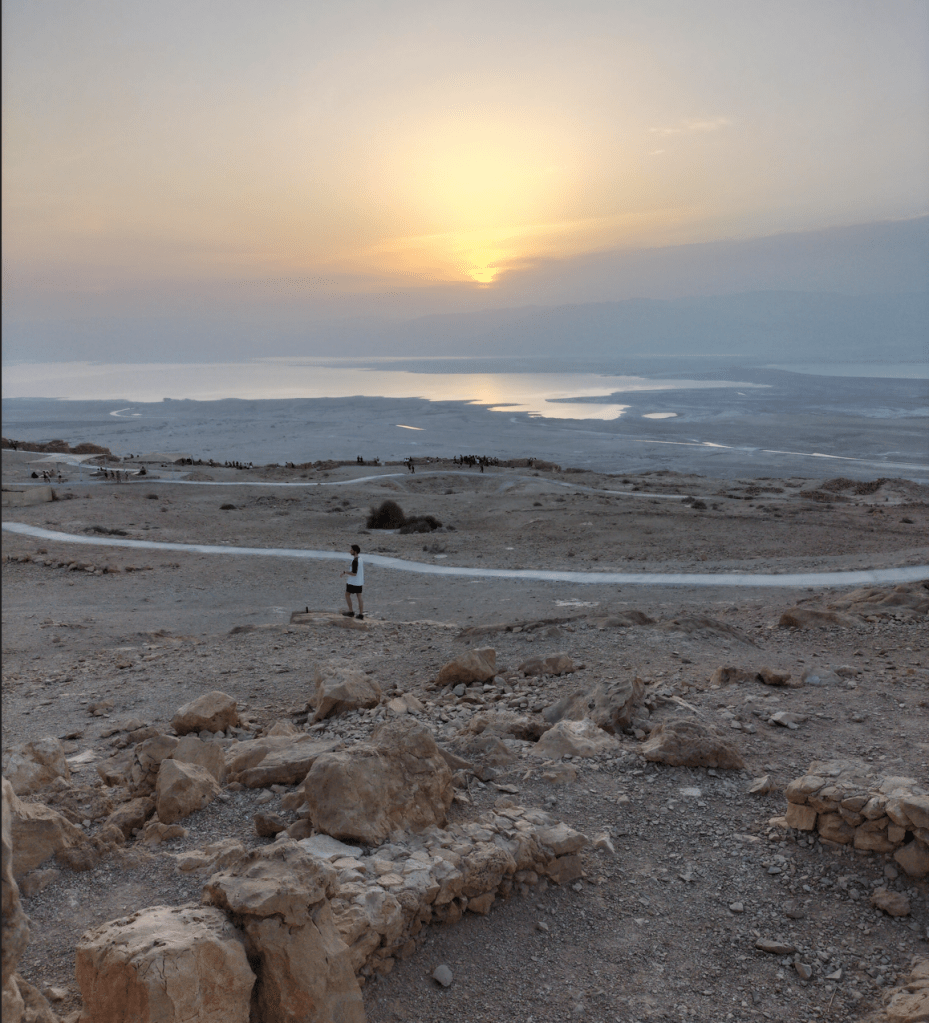
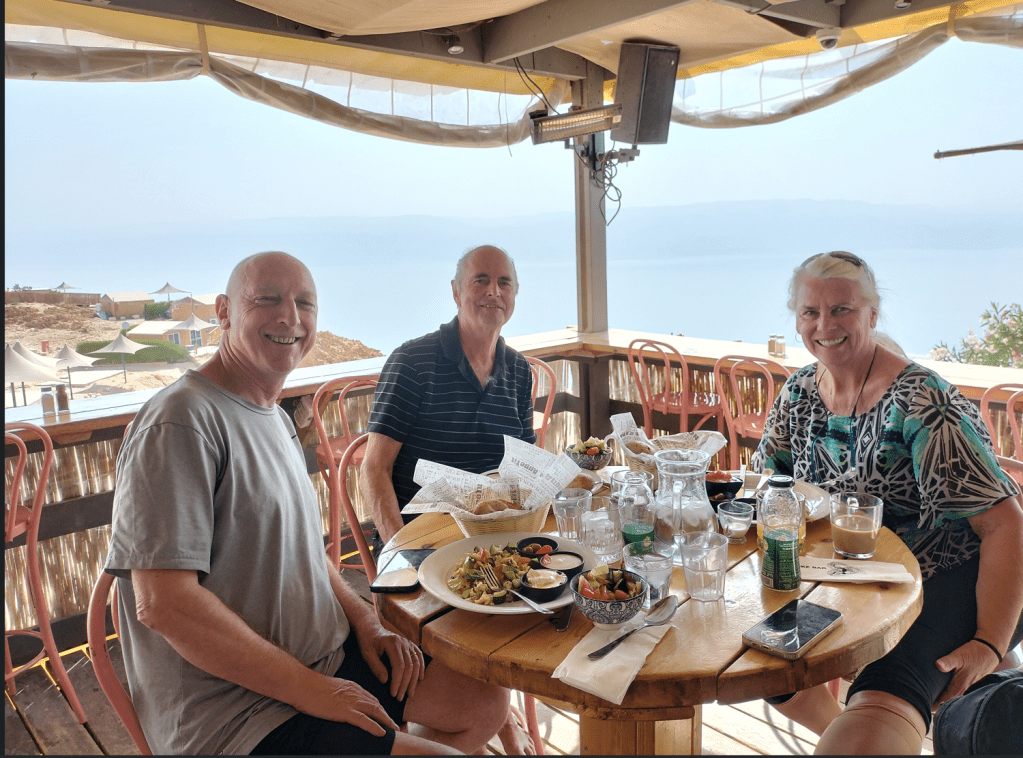
After we got back to the car park After we got back to the car park we went for breakfast at a camp overlooking the Dead Sea, the morning sun shining over the water was as stunning as the breakfast was delightful, made more so by the young man who served us, he even asked us what music we would like to hear as we enjoyed our meal.
Then is was on to a historic item. We visited a railway museum with railcars and buildings dating back to the early 1900’s. The Ottomans were the first to commence steam rail travel in the late 1800’s and, as elsewhere steam travel played a part in developing the economy.
We proceeded north to Bet Sheen, a national park in which there are archaeological remains of a Roman town. We also rented a kayak and floated down the Jordan River for a couple of hours. I did most of the work as Lorna and David enjoyed the scenery.
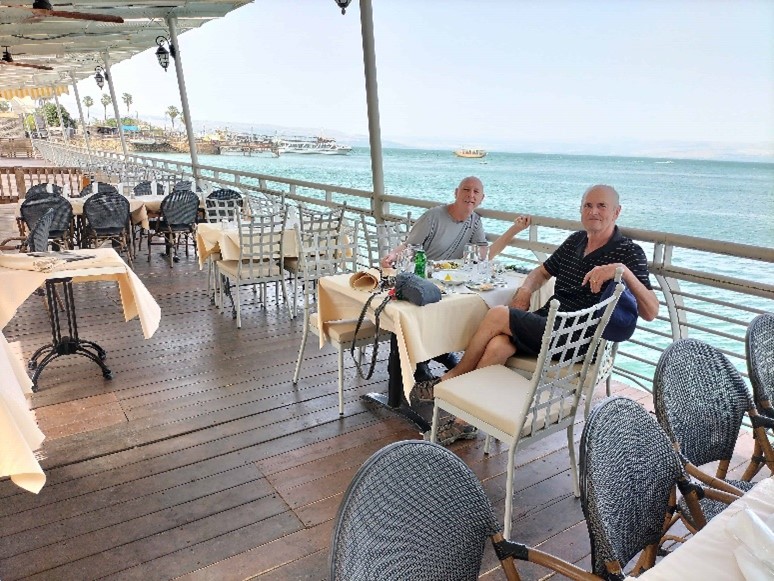
We stayed overnight in Tiberius a large town with a brilliant location on the shores of Galilee but which has unfortunately not received the care it needs; its presentation is quite shabby. We did however enjoy a brilliant evening meal, the best lamb chops I have ever tasted. The Airbnb we stayed in was quite comfortable, it had a large entertainment area and a small swimming pool.
The following day we went to Capernaum, the area in which Jesus had spent most of his time. There are a number of sites to see from the Church of the Beatitudes to the Churches of Tabgha. There were residences for visiting clergy and several meeting places down by the water. There was also a small monastery with dramatic pictures depicting Biblical stories.
After a swim in the Galilee at Amnun Beach we reluctantly got back in the car to travel to Jerusalem where David kindly dropped us after a truly delightful three days.
The following day we went to Capernaum, the area in which Jesus had spent most of his time. There are a number of sites to see from the Church of the Beatitudes to the Churches of Tabgha. There were residences for visiting clergy and several meeting places down by the water. There was also a small monastery with dramatic pictures depicting Biblical stories.
After a swim in the Galilee at Amnun Beach we reluctantly got back in the car to travel to Jerusalem where David kindly dropped us after a truly delightful three days.
Jerusalem – Old CIty
We could not have arrived in Jerusalem as a worse time. It was the evening before Jerusalem Day celebrations commemorating, among other things, the reunification of the city in 1967. On top of that it was the first time in three years that public gatherings were permitted. After considering advise from the Airbnb hosts, and David’s knowledge of the City, we were dropped off at Jaffa Gate and walked to our accommodation. Despite the seething mass of humanity going in the opposite direction we navigated our bags past the Tower of David, down to St James St and found the location at the bottom of Ohr HaHayim. We retrieved the code for the door lock from WhatsApp and made our way up several stairs, and a narrow spiral staircase to the roof-top unit. It was now 11:00pm at night so we climbed into bed and, despite chanting youth on the street below, we fell asleep. In the morning we were greeted by a view across the roof-tops to the Dome of the Rock.
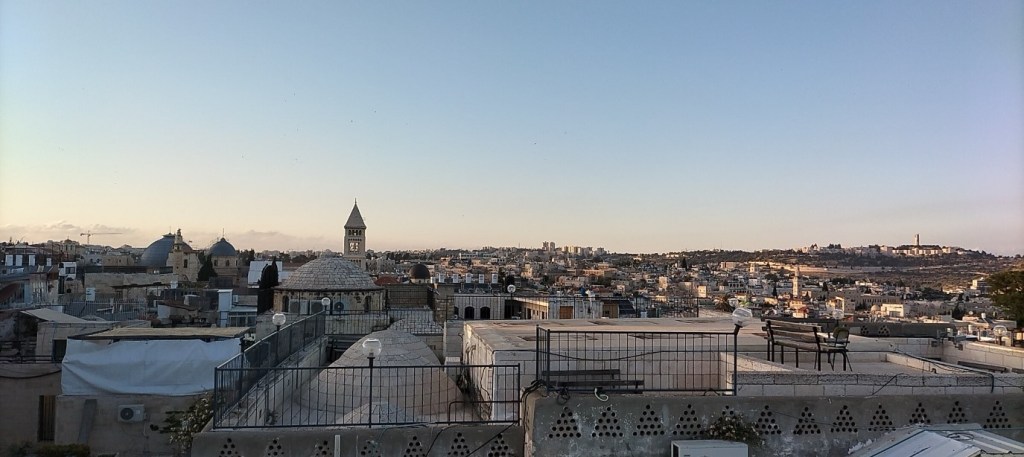
We returned to the Tower of David, which houses museum exhibits on the history of Jerusalem, including a large model created by Hungarian, Stephen Illes for the 1873 Vienna World Fair. The Tower also include many video presentations on the various eras of Jerusalem rule from the Biblical period to the Muslem rule to the Ottomans to the current Jewish administration.
The Western Wall was the next destination, It too was infested by chanting youth singing nationalistic songs and waving the national flag. The Wall itself is continually fronted by a wide variety of people from those in orthodox garb to others in shorts and tee shirts. To the left are covered cloisters where the more serious students of the faith are reading and learning the Torah.
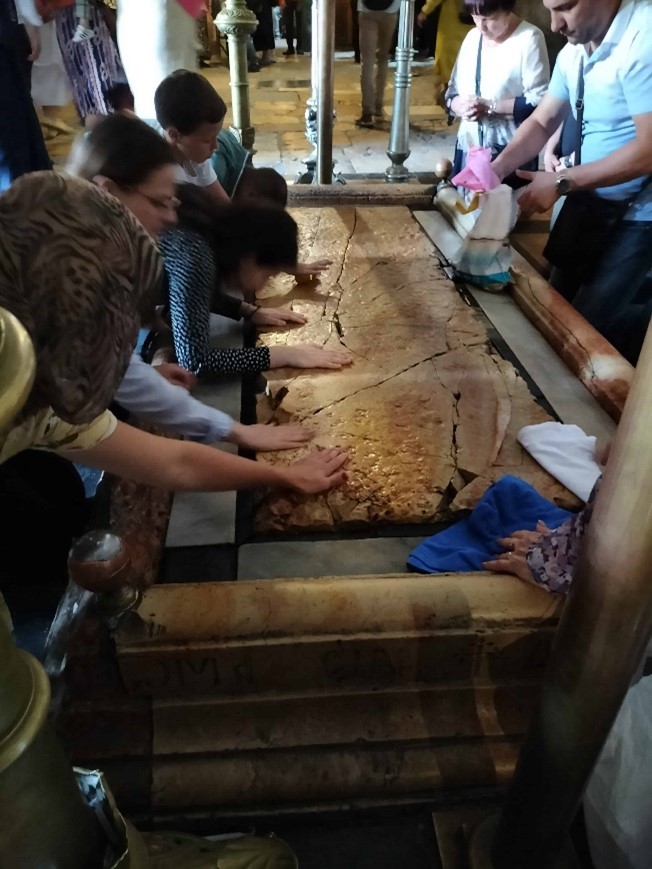
The other landmark we visited was the Church of the Holy Sepulchre. It is a large cathedral with several sections. The building marks the location where Jesus was supposedly buried, although the church was not built until centuries later. There is also the stone where Jesus’s body was supposedly laid in preparation for burial. The cathedral is at the top of the Via Dolorosa where the 12 stations of the cross are located. It’s all rather depressing seeing that none of it existed at the time od Jesus’ trial and crucifixion.
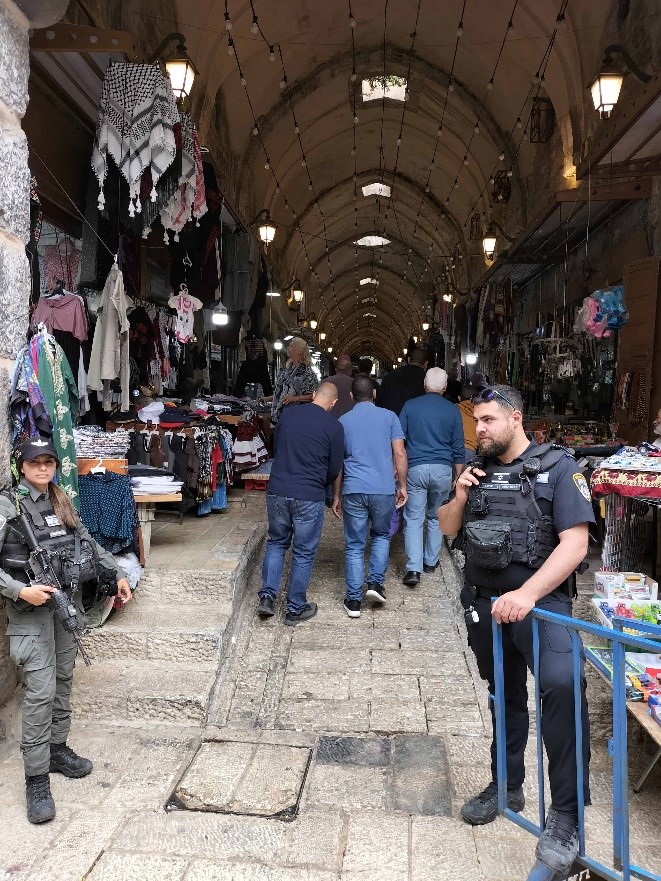
Walking the streets of the Old City is in itself awe-inspiring. It is a myriad of stone walkways through the Jewish, Muslim, Armenia and Christian quarters. There are multiple ‘souk’ areas with all kinds of different stores and restaurants. On Sunday, after attending the Lutheran Reformed Church, where we greeted by the pastor we had met at the International Church of Prague two weeks earlier. We then left the Old City and went to the bus station to take the bus south to Eilat.
Eilat
Eilat is a tourist town. It sits on the Red Sea and is the southernmost city in Israel some four hours drive south of Jerusalem via highway 90. It’s a popular place to holiday and to take the children for a break. It has beaches all kinds of restaurants many large hotels and amusement rides. It is a rapidly growing city with much construction of more vacation experiences and hotels underway. It’s also a port, the only Israeli port on the Red Sea, and it’s a free trade zone for transiting cargo.
We arrived in Eilat by bus and set about finding our Airbnb. The first taxi I showed the address to handed the paper back and said he didn’t know where Shaldag St. was. The second typed the street into Google Maps and said she could take us there for 30 shekels. When we got to Shaldag Lane I was skeptical but she said they were the same. The number was right so we got out and retrieved our luggage from the boot and set about to find apt 1. The first sign something was wrong was apartment one was up some stairs, it was supposed to be on the ground floor. A knock on the door elicited what I assumed was a “who’s there?” To which I replied “Graham”. An Israeli man opened the door allowing me to see into a messy apartment, rather than a newly cleaned rental unit. I showed him my confirmed reservation sheet to which he replied “wrong place,” handed me back the paper and closed the door.
We tried to find someone to help us, the third person we asked could speak some English and he spied a phone number on the registration form which he called. He determined that the building we had been at was indeed the right one but the desired apartment was around the back. He elicited another useful piece of critical information, the code to the lock box that held the front door key. We went back to the building and went around the back where we found two apartments, neither were numbered. I tried the lock box outside the first which stubbornly refused to open. When I keyed in the code on the second lock box it sprang open revealing the front door key. Inside was a newly renovated unit with a double bed, shower, toilet and kitchenette. There was a coffee machine that required pods but no pods, nor was there any soap or shampoo. I sent a message to the host and later that night he dropped off the used promised essentials.
We went out to look around the town to find something to eat and buy some milk for our coffee in the morning.
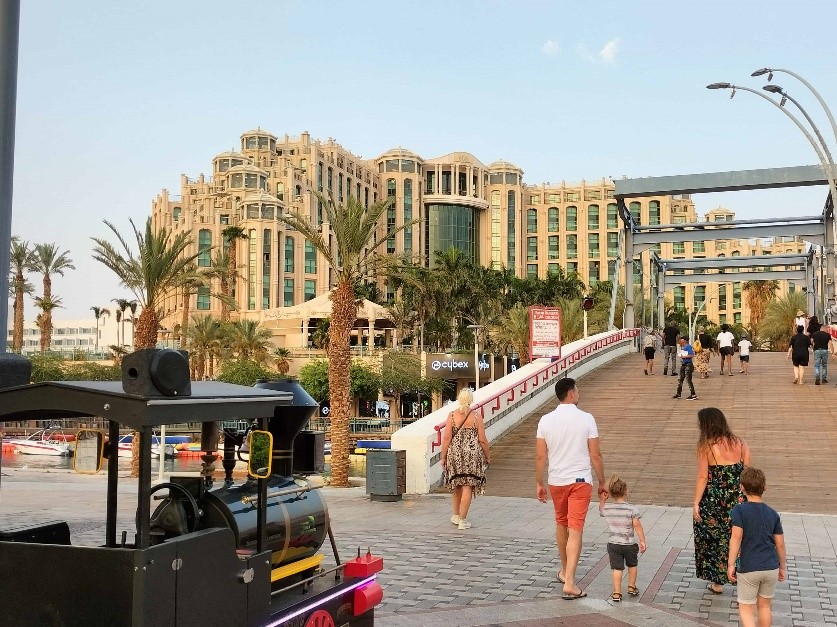
We walked down to the beach and regretted not wearing our bathers. The water was clear and warm. Walking along the promenade we remarked on the number of high-priced stores claiming “discount outlet” status but with exaggerated prices. We were also accosted by a man touting for local restaurants, we eventually retired for the night getting ready for the most extraordinary day of the trip. We awoke at 6:30 and had our coffee after which we packed our bags and walked back to the bus still wondering why we had taken a taxi the day before. We had to buy a Rav dash key card and a minimum 30 shekel balance for a nine shekel fair even though we would be leaving the country within the hour. What we had been told that it was a 7 minute ride to the border, turned out to be wrong. The number 15 bus goes all around the town before heading to the border 30 minutes later.
At the border the fun begins. On the Israeli side you must have your bags and passport checked before the privilege of paying 20 florins to leave the country. The process is somewhat mechanized as there was a channel for biometric i.e, facial recognition, passport control. Nothing similar was to be experienced on the Egyptian side.
Taba – Egypt
The first stop on entering Egypt is a luggage check with everything being deposited on the luggage conveyor to be x-rayed. The only bag not to pass muster was my briefcase which was subsequently searched. The item of interest was a package of aspirin which no doubt looked like amphetamines. Eventually the bag was returned to my care and we were waved on to the next building. The first desk contained entry cards to be filled in with passenger details, but all the cards were being held by young men who were filling them out for travelers, for a fee. I explained that I did not have any Egyptian pounds so they relieved me of 50 shekels. The next stop was passport control but as I marched towards the desk I was guided back to the currency exchange desk where I transferred my last few sheckles into Egyption pounds which, I was about to find out, was fortunate. Passport control converted the online visas I had acquired a month earlier to an efficient stamp in our passports and we proceeded to another desk, the purpose for which was to scan our passports again and relieve me of a couple of the newly minted pound notes. The final hoop was a middle-aged man in a white uniform whose purpose in life was to flick the through people’s passports. We then entered into the sunshine for the next step in our odyssey. We were told to take a Weebus minibus from Taba Heights to Cairo. I was then accosted by an old man inquiring where I wanted to go, I told him Cairo and he quoted me a price in pounds and U.S. dollars. Concerned my meagre pounds would run out before I could pay for the eight hour trip to Cairo I opted, to the old man’s glee, for the 30 U.S. dollar option. Then, assuming we were about to go, we boarded the already nearly full maxi van and waited. We had to record our names and passport numbers on a form and we waited some more. It took about an hour for the remaining seats to be filled and, after a police check consisting of a sullen faced Defence Force person casting his eyes in our direction, we were allowed to depart. After several stops we finally arrived at Taba Heights which consisted of a petrol station with toilets and a shop. As we pulled up we saw a Weebus minivan and deposited our bags optimistically beside it. I then went to find the driver who was buying a coffee and asked if he was going to Cairo. I never did get an answer but was told I had to register with head office. I explained I had no Egyptian SIM so the kind man at the cash register phoned the number for me. After several calls dropped out, the call connected and the man explained our situation and an English speaking girl took our reservation for the 12:00 PM departure which would be there by 11:00 AM. We reluctantly retrieved our bags from beside the 10 AM departure and sat down at a table for a coffee. Presently a van dropped off, a delightful Spaniard in her mid 20s who was a belly dancer returning to Cairo after a week’s engagement at a local hotel. She spoke good English and happened to know Ahmed, the driver who was to drive us to Cairo. She even had his phone number and, as 1145 reared its head, she called his number and announced that the van would be there in 5 minutes. It was 12:20 when he finally turned up, relieved me of 660 pounds, but still we were not invited to board. Presently another couple turned up and we got up to board the bus but we were told to sit down. Eventually another traveler joined us and by the time the 12 PM service left Taba Heights it was nearly 1:00 PM. Our expectation of a six to seven hour journey soon dissipated as we left the main road three times to pick up additional travelers. By the time we got to Saint Catharines for the last pick up all the 12 seats were filled and the suitcases that had been in the rear were tied on the roof.
Leaving Taba we started to notice many half built resorts that were fenced off with no one living in them, most were empty concrete structures that had never been finished. The driver said the whole area had been declared a restricted area but the real reason was the crash of Egyptian tourism after the 2011 revolution.

The road was particularly perilous as it was only one lane either way with our driver consistently driving at 120 kilometres per hour. He extracted every ounce of torque from the van’s 4 cylinder engine to veer onto the wrong side of the road to pass trucks, buses and cars deemed to be travelling too slow. Every 50 kilometres or so there was a barrier in the road at which we had to stop for a police check. It seemed that half the Egyptian Defence Force are stationed at roadside checkpoints. All our passports and travel cards were kept in a cubbyhole by the driver. Presently, we reached St. Catharines. We had been told we would not stop, other than to pick up a final passenger, the police had other ideas. I learned later that we had too many international passengers and we had to stop for an hour for the police to complete our passport checks. During the stop I had an interesting discussion, over a cup of tea, with an engineer who was working for a consulting company overseeing the construction of a new city at Saint Catherines
Leaving the hamlet we were suddenly in drivers Nirvana. The skinny roads we had experienced to that point were replaced with enough bitumen for three lanes either way. The driver made good use of the new roadway expertly swerving at the right time to stay on the finished surface and avoiding hitting the steam rollers on the new sections. We cruised at 140 kilometres per hour making up some of the time lost at Saint Catherines. As we approached the Suez Canal tunnel the road had grown into a half mile wide thoroughfare with three lanes either way going to 6 to 12 lanes at the checkpoints, it is an impressive piece of infrastructure. The toll collection for the tunnel is, however, totally manual with staff mindlessly connecting money from the drivers of transiting vehicles. The speed in the tunnel is posted at 60 kilometres per hour, we went 120 KPH. It is a two hour drive from the tunnel to Cairo. As we approached the Capital the driving changed. With the new infrastructure there must be better monitoring and the driver slowed down to the speed limit at certain points and put on his seat belt, only to release it again a few kilometers down the road. There was also a change in his use of lanes. As the traffic grew heavier the driver straddled 2 lanes moving into one or the other depending on which was moving faster. This actually increases the efficiency of the roadway. A road marked with three lanes can accommodate 4 lanes of traffic. It does of course mean the vehicles are perilously close to each other and it requires precision driving to optimize your lane usage, but with a beep of your horn you can dominate the traffic around you. In fact, the cars horn is the most important component in a passenger vehicle. It allows you to flagrantly defy road rules.
Cairo, and chaos
Typically one’s initial experience in Cairo is from a road either from the airport or from a bus window. It is immediately obvious that road rules are for guidance only, with enforcement virtually impossible. Vehicles vary from the most advanced tourist bus to horse drawn carts. In between is every kind and size car, mostly scratched, motorbikes, motor scooters, motorized bicycles and yak yaks. Virtually no rider of a two wheeled vehicle wears a helmet although I did see one wearing a full face shield; at least his face would look good for the funeral. The most important component of any vehicle in Cairo is the horn. It is used for the obvious, to alert people of your impending arrival, to advise that you are about to turn right from the left hand lane, or simply in the hope of magically moving on traffic stuck in front of you.
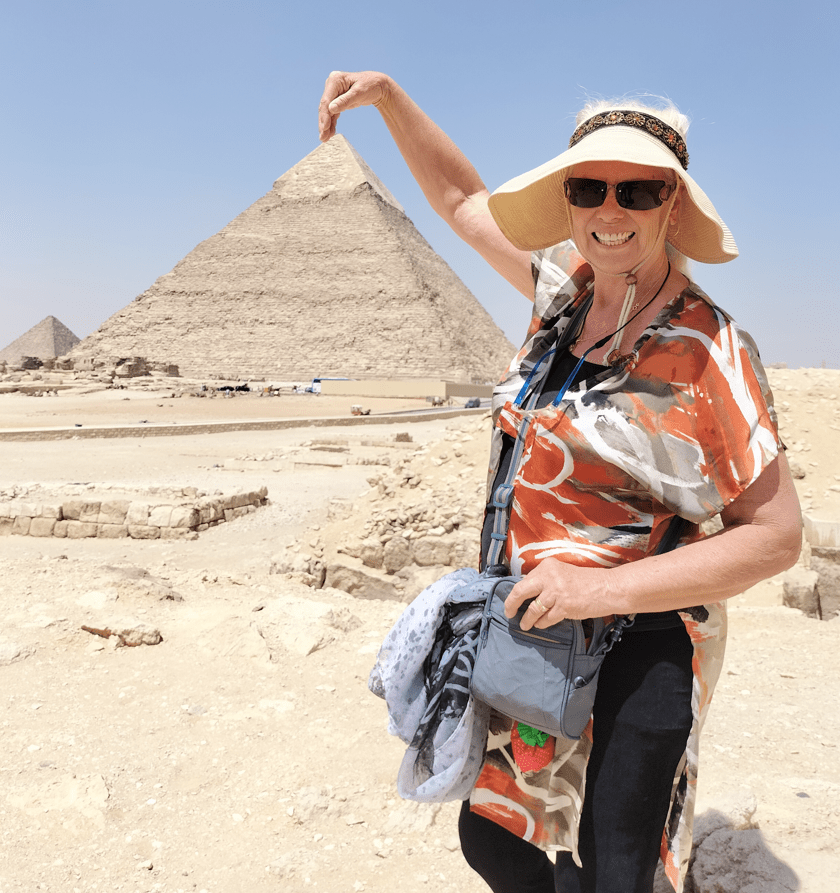
We took a trip to the Pyramids at Giza and enjoyed watching the tourists riding camels and taking pictures
We went to the Cairo Museum which hasn’t changed much in the 30 years since I had been there before, I’m sure some of the exhibit description cards were the same ones I’d seen before. There were also a number of exhibits that had been packed up awaiting their move to the new Cairo Museum, that should have happened several years ago but is still pending.
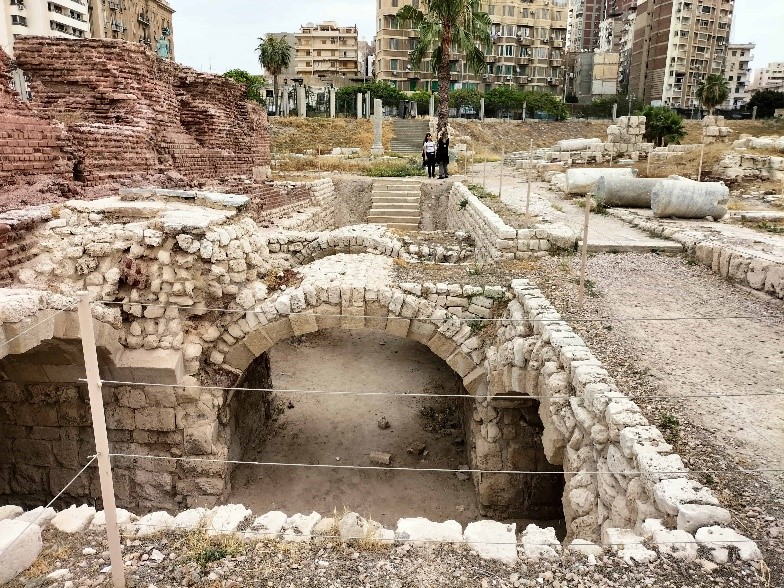
Perhaps the highlight was the day trip to Alexandria on the Mediterranean coast. It is a very historical city in a beautiful setting.
But it was with a tinge of sadness that we travelled back to the airport for our return flight via Abu Dhabi and Singapore. Cario has lost the vibrancy that I expereinced 30 years earlier. The crushing effect of corruption and lack of demogracy is stark. People are poor, education seems quite basic and unemployment quite high. For many men the morning highlight is coffee [Turkish] and a smoke [pipe]. The afternoon joy is adding a game of dominoes to the mix. The employed are typically in menial jobs. We saw many young men with 12 years of schooling under their belt whiling away their hours at roadside checkpoints, waiting for something to happen.
Then there are the homeless, families sleeping in stifling heat as pedestrians walk by, some selling packets of tissues to make a few shillings. I felt particularly sorry for one woman with three children living between a wall and the busy road. What kind of future do they have?
Infrastructure is in terrible disrepair. Most pedestrians walk on the road because the paths are dangerous: loose papers, uneven trials, large holes all make walking on the footpath perilous. Many buildings are historical and have not been maintained; paint peeling, concrete facades crumbling exposing the bricks beneath, balconies being held up with wooden braces nailed together at strategic points.
As we boarded the flight, exhausted and enthralled at the journey we had been on, we realised how truly priviledged we are to call Australia home.
 Williamson Author Site